Specifications are contracts
Structured, versioned definitions describe what is being implemented independently of one target technology.
Open-source specification infrastructure
Define your system in structured specifications. Compile it into the languages, schemas, and implementation artifacts your stack needs.
Own the specification. Portable WASM plugins handle the implementation.
name: Account
fields:
  ID:
    type: UUID
  Status:
    type: String
identifiers:
  primary: ID
$ kalo compileresolved · pinned · localCurrent proof / Morphe
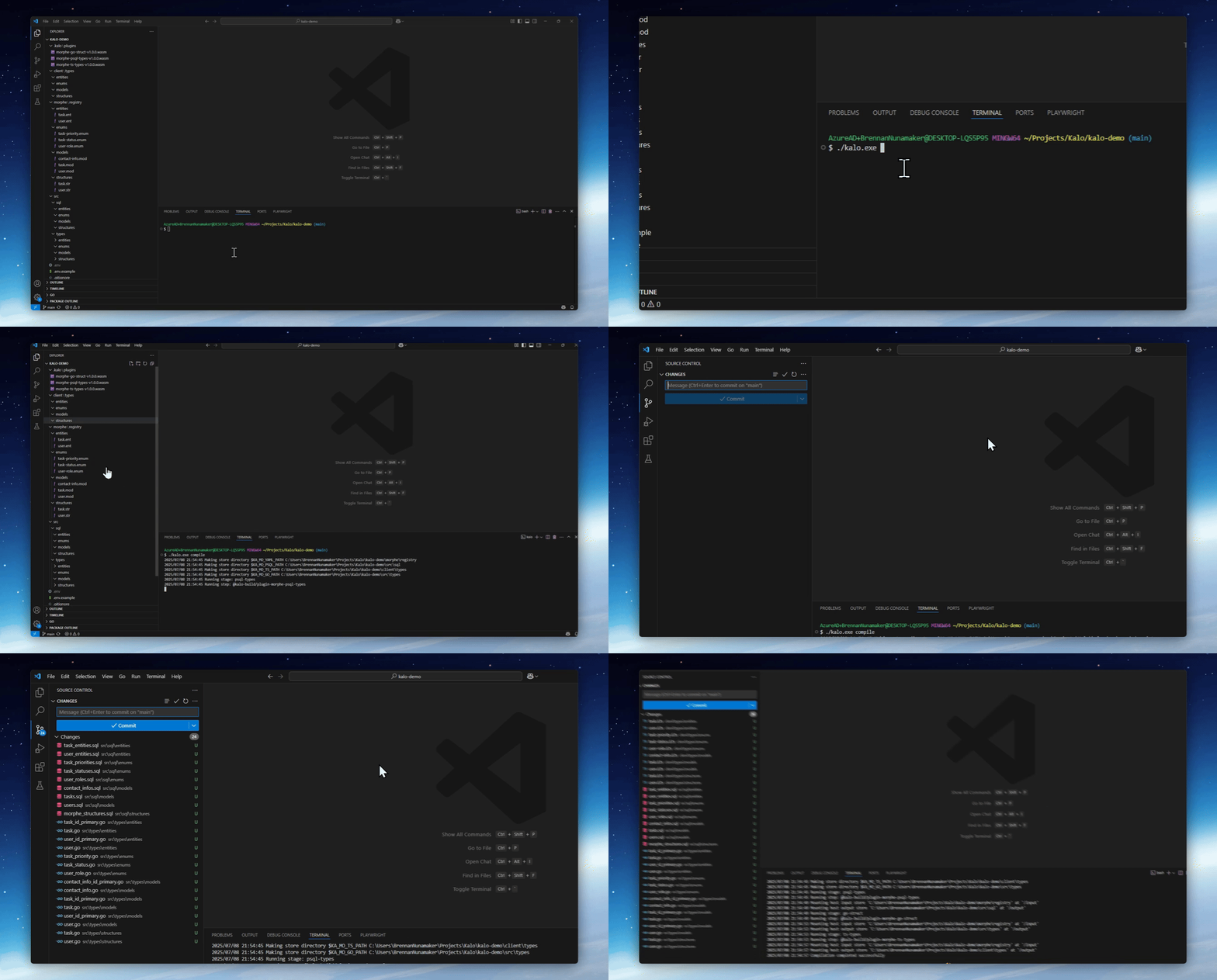
Morphe is Kalo's first specification ecosystem: a human-readable YAML model can be compiled into concrete Go, TypeScript, and PostgreSQL representations.
How Kalo works
Kalo is the pipeline and plugin infrastructure. Morphe is one specification built on top of it.
Structured, versioned definitions describe what is being implemented independently of one target technology.
A specification can define canonical source formats and explicit target representations without collapsing the two.
Portable WASM plugins consume declared inputs and produce declared outputs across a controlled boundary.
Kalo connects transformations into named, repeatable workflows that can branch across your stack.
What “zero lock-in” means
Kalo does not promise cost-free migrations. It gives your system an architecture where the specification can outlive any one generator, language, or framework.
Specifications live with your project, not inside a proprietary runtime.
Generated code and schemas are ordinary implementation assets.
Change generators or target technologies without redefining the model.
WASM keeps transformations independent of a single plugin language.
Architectural direction
Standards often describe related concepts across schemas, profiles, protocols, and implementation environments. The mapping, validation, and code required to operationalize them is repeatedly rebuilt.
Kalo provides primitives for expressing those relationships as reusable, versioned transformations and validation pipelines.
Kalo is exploring where this architecture can reduce repeated integration work in open-standards ecosystems.
Specification A → Specification BCanonical model → target profileSpecification → implementation artifactsSpecification → validation checksVersion N → version N+1The Kalo ecosystem
Products, open tools, and research around making system knowledge explicit, portable, and usable by humans and machines.
Scattered inputs → reviewable cases
Velota prepares recurring cases from emails, forms, documents, and existing systems while keeping consequential decisions under human control.
Development activity → durable intent
Local-first context for AI-assisted software development. Recover project intent, scope bounded work, preserve evidence, and hand work between humans and coding agents.
Architecture choices → durable rationale
No-sign-up tools and reference material for Architecture Decision Records. Generate canonical formats as ordinary Markdown and keep the rationale in your repository.
Experience + outcomes → learned scoped rules
Research into discovering predicates, contextual rules, and useful structure from events and outcomes—then testing what can safely transfer into another bounded context.
These products, tools, and experiments share an architectural thesis; they are not presented as a fully integrated technical stack.
Technical preview
Kalo reads a project-local kalo.yaml that declares its stores, plugins, and named pipelines. Install the declared plugins, inspect the workflow, then run its compile pipeline.
# stores + plugins + compile pipeline configured
$ kalo install
$ kalo list
$ kalo compileVersioned application data modelling.
Canonical source and documented targets.
Real repositories, real generated artifacts.
Source of truth ≠ implementation of the moment